Paperwork Paradise or Bureaucratic Purgatory?
Alistair McKechnie · 10 November 2026 · 9 min read
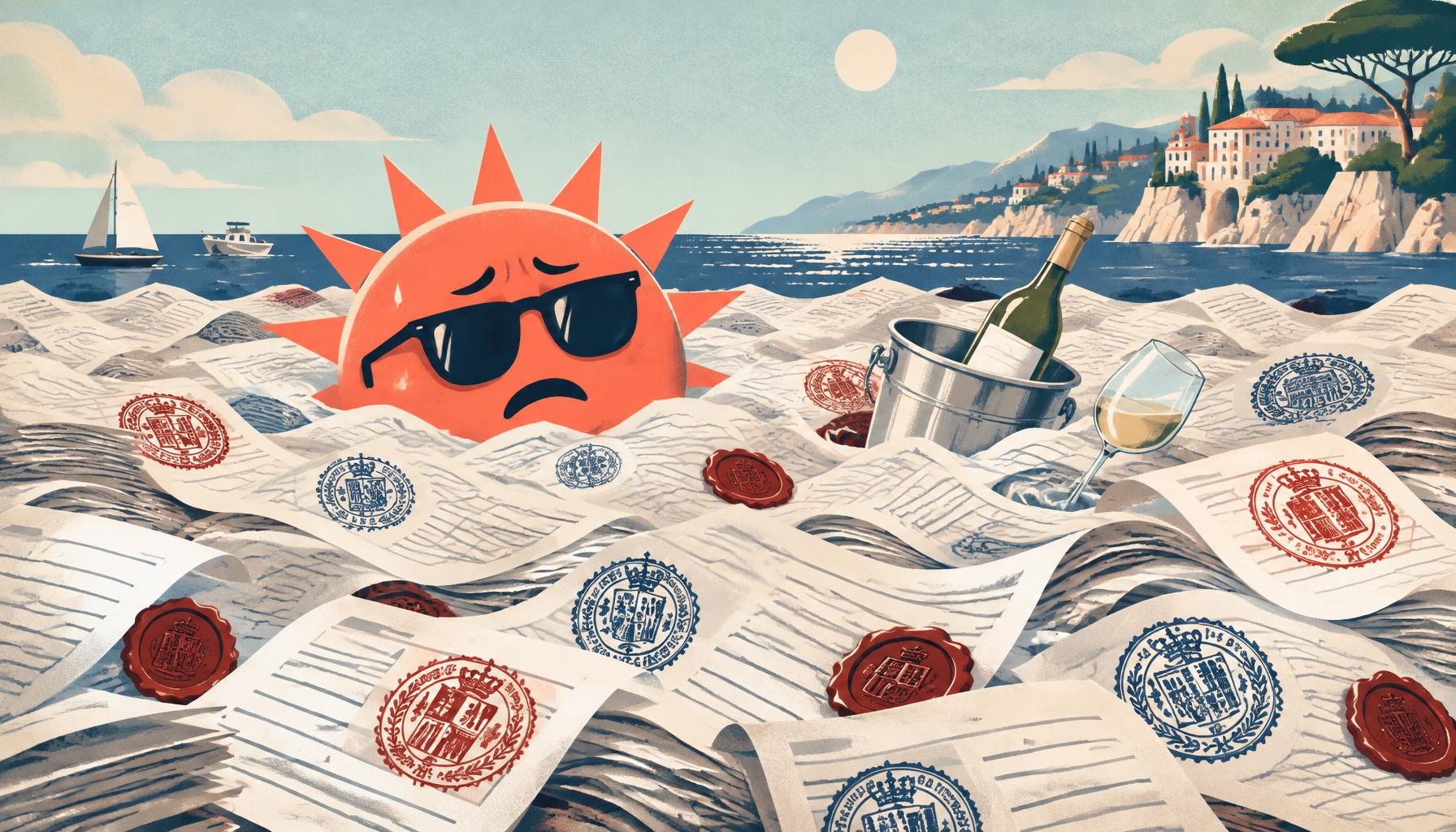
Ranking the Med’s Retirement Hotspots by How Much They’ll Make You Weep at a Government Counter
Escaping to the Med for a life of blissful relaxation? You can be sure there’s a local official who’s even more relaxed. Alistair McKechnie takes a sideways look at the art of Mediterranean mañana.
Everyone dreams of the same retirement scene: a sun-drenched terrace, a glass of something local, and an olive grove you can legally claim as your own. What Instagram tends to ignore is the less charming flipside: you, clutching a folder of apostilled documents, standing outside an office that closes at 1pm on a Tuesday for reasons nobody can explain.
So let’s talk about the unglamorous part of the dream: how hard is it to get things done? We’ve looked at the Med’s most affordable destinations through three lenses: buying property, sorting out residency, and dealing with the taxman. Rules change often in this part of the world, so treat everything below as a guide to the flavour of each system, and double-check current requirements with an official source or a good local professional before you commit a cent.
A quick universal truth first: in every one of these countries, the single best investment you can make is a local lawyer or gestor who does this for a living. They cost a few hundred euros. They save you months of your life. Think of it as paying someone to be quietly desperate on your behalf.
Croatia: The Unexpectedly Grown-Up One
Croatia joined the EU, Schengen and the euro in recent years, and it shows. It’s tidy, it’s embraced digital, and the system mostly behaves as advertised. You’ll need an OIB (personal tax number), which is refreshingly straightforward to obtain. Non-EU citizens can buy property subject to reciprocity rules, which most Western nationalities (including Americans and Brits) satisfy, though the approval step adds some paperwork.
Residency for non-EU retirees runs through a temporary stay permit, typically requiring proof of income or savings, health insurance, a rental contract or property ownership, and a clean criminal record. It’s paperwork-heavy but predictable. The main complaint is less “chaos” and more “this office wants a document the other office already has.”
Verdict: Not fun, but fair. You’ll leave the counter annoyed, not traumatised.
Spain: Wonderfully Organised, Once You Secure Your Appointment
Spain is the Premier League of retirement bureaucracy: huge numbers of foreign residents mean the system has seen every possible mistake before. Buying property is well-oiled. You get an NIE (foreigner’s ID number), open a bank account, and a notary handles the signing. Lawyers and gestorías are everywhere and affordable.
The pain point is the cita previa, the appointment system. In some regions, securing a slot for residency or fingerprinting feels like trying to score Glastonbury tickets. Residency options for retirees, such as the non-lucrative visa, require proof of substantial passive income and private health insurance, and standards can vary between consulates and regions. Spain also ended its property-based golden visa in 2025, so don’t plan around that one.
Taxes are the other thing to respect: once you’re resident, you’re taxed on worldwide income, there are declarations for overseas assets, and the regions run their own wealth and inheritance rules. Spain is organised, but it will absolutely find you.
Verdict: Efficient machinery, occasionally guarded by a booking system with a personality disorder.
Greece: Digital Ambitions, Analogue Soul
Greece has made real progress. The gov.gr platform handles an impressive amount online, and the tax number (AFM) is easy to get. Property purchases need a lawyer, a notary, a tax clearance, and a hard look at the title. The land registry is still being completed in parts of the country, so a thorough title check is non-negotiable. Skimping here is how people end up buying a house with an unexpected co-owner called Uncle Kostas.
Residency is available through financial-means routes and the investment-based golden visa, which has been tightened with higher thresholds in popular areas. Processing times vary, and you’ll be relying on the patience of a country that invented the word “philosophy” and has applied it generously to deadlines.
Verdict: Better than its reputation, as long as you hire someone competent and bring snacks.
Albania: The Plucky Overachiever
Albania punches above its weight in digital government. The e-Albania portal handles lots of services online, residence permits are relatively accessible, and the whole country is small enough that someone usually knows someone who can help. Foreigners can generally buy apartments, though rules on land are stricter and there are location restrictions in some cases.
The catch is that property titles can be murky, a legacy of decades of upheaval, and coastal development has moved faster than record-keeping. A proper legal check isn’t optional. It’s the entire plot of the movie.
Verdict: Cheap, quick and charming, with one big asterisk shaped like a land registry.
Portugal: The Victim of Its Own Popularity
Portugal is beloved by retirees, and the system has buckled a bit under the love. Buying property is fairly smooth: get a NIF (tax number), find a lawyer, and proceed. Many buyers say this is the easy bit.
Residency is where things get spicy. The immigration agency AIMA, created after the old border service was dismantled, has had a well-publicised backlog, and appointments and renewals have been slow. Retirees on the popular passive-income (D7) visa have had to be patient. Tax rules for newcomers have also shifted: the famously generous Non-Habitual Resident regime was replaced by a narrower scheme, so older tutorials and YouTube videos can be dangerously out of date.
Verdict: Lovely country, lovely people, and a waiting room with a lot of lovely people in it.
Turkey: Fast, Flexible and Faintly Terrifying
Turkey can be shockingly efficient in places. Title deed (tapu) transfers can happen in a day, and the property market is accustomed to foreign buyers. Alongside this is a military-clearance check on the property, mandatory valuation reports, and a tendency for rules to be updated with little warning.
Residence permits are available to property owners and others, but authorities have restricted new permits in a number of popular districts that were becoming saturated with foreign residents, and requirements keep being tweaked. Add exchange-rate swings and inflation, and you’ve got a system that’s excellent at speed and less excellent at predictability.
Verdict: A rollercoaster. Thrilling if you like rollercoasters, unwise if you’ve just had lunch.
Montenegro: Stunning Scenery, Paperwork by Treasure Map
Montenegro is gorgeous, outside the EU, and still working on its administrative polish. Foreigners can buy property (with some limits on certain land), and temporary residence is often tied to ownership or a rental agreement, plus health insurance and proof of means. Small offices can be friendly, but procedures can be inconsistent from one official to the next, and rules have been revised repeatedly.
Crucially, you’ll want a lawyer who actually knows the current process, not the process from a blog post three years ago.
Verdict: Spectacular fjords, challenging forms. Charming right up until you need a stamp.
Italy: La Dolce Vita, Il Dolce Modulo
Italy is the legend. It is brilliant at art, food and the concept of the three-hour lunch, and not obviously brilliant at consolidating forms. Buying property is manageable because notaries do much of the legal heavy lifting. Getting a codice fiscale (tax code) is easy. After that, things slow down.
The elective residency visa for retirees requires substantial passive income and proof of accommodation, and local offices (the questura for permits, the comune for registration) can vary wildly in efficiency. Italy has also been courting retirees with a flat-tax incentive for those moving to certain southern towns, but eligibility rules are specific and worth verifying in detail. Italian bureaucracy is rarely impossible; it’s just rarely quick, and it loves a stamp.
Verdict: You will emerge with a deeper appreciation for patience, espresso and the word “domani.”
The Big Table of Subjective Suffering
| Rank | Country | Buying a Home: Will I Need a Lie-Down? | Residency: Wait Time in Existential Dread | Taxes: Will They Find Me? | Overall Vibe |
|---|---|---|---|---|---|
| 1 | Croatia | Mild: a few forms, no fainting | Predictable, paper-heavy | Yes, politely | “Surprisingly adult” |
| 2 | Spain | Smooth, with a gestor | Fine, if you win the appointment lottery | Yes, thoroughly | “Efficient, with a booking-system boss fight” |
| 3 | Greece | Do the title check or else | Variable, bring snacks | Yes, increasingly digitally | “Better than its reputation” |
| 4 | Albania | Quick, but title risk is real | Relatively accessible | Yes, but it’s a small country | “Plucky overachiever” |
| 5 | Portugal | Easy bit of the process | Backlogs are the main event | Rules keep changing | “Victim of its own popularity” |
| 6 | Turkey | Lightning-fast, with caveats | Rules shift often | Yes, plus currency drama | “Rollercoaster” |
| 7 | Montenegro | Doable, patchy process | Inconsistent between officials | Developing | “Unwieldy but gorgeous forms” |
| 8 | Italy | Notary-led and manageable | Slow, local-office-dependent | Yes, with ornate paperwork | “Il Dolce Modulo” |
Ratings are subjective and based on general reputation and typical experiences. Your mileage, and your clerk, may vary.
Final Thoughts: Choose Your Pain
No Mediterranean country is paperwork-free. The realistic question isn’t “Which one has no bureaucracy?” but “Which flavour of frustration can I live with?”
If you want predictability, Croatia and Spain are your friends. If you want speed and low costs and don’t mind doing diligence, Albania and Turkey deserve a look. If you want scenery, culture, and great food and don’t mind a rich marinade of mañana, Italy, Portugal and Greece will repay your patience handsomely.
Whichever you choose, do four things:
-
Hire a local lawyer or gestor before signing anything.
-
Get documents apostilled and translated early. Do it before you’re asked.
-
Check official government sources for current visa and tax rules, because blogs (including this one) age fast.
-
Build in buffer time. Whatever the website says, add a month. Then add another.
Do that, and the only thing standing between you and that terrace is a final stamp. Possibly two. Domani.
Of course, before you decide which flavour of bureaucracy you want to devote the next years of your life to, you need to see what kind of lifestyle your retirement income will entitle you to. And we have exactly the right calculator to do that for you here at Pensionmaxxer.com
Disclaimer: This article is opinion, not legal or tax advice. Always verify current rules with official sources and qualified local professionals.
See it for your own pension
Compare after-tax income, spending power and visa options across countries.
Run the comparison